
The Digital Cul-de-Sac: Real Estate at the Crossroads of Innovation and Legacy Systems
Imagine you are a high-volume property manager in 2025. You’ve just integrated a state-of-the-art AI predictive maintenance tool that promises to save you 40% on emergency repairs
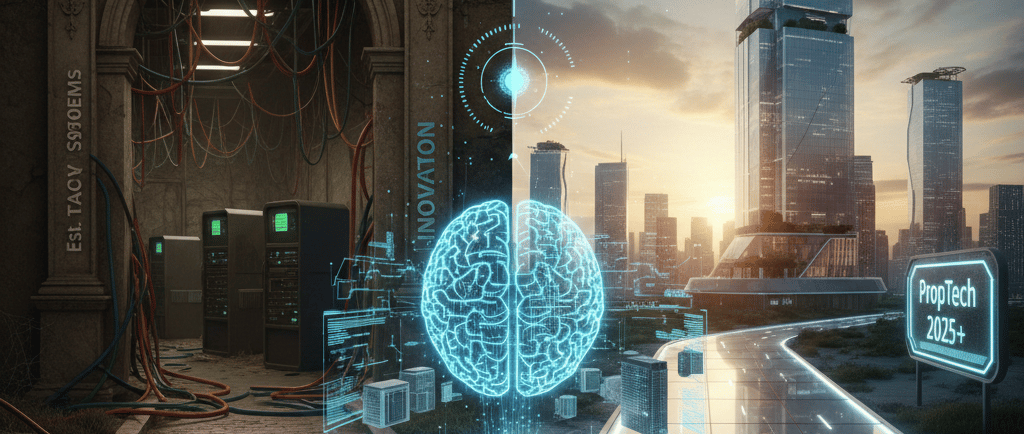
The Digital Cul-de-Sac: Real Estate at the Crossroads of Innovation and Legacy Systems
Imagine you are a high-volume property manager in 2025. You’ve just integrated a state-of-the-art AI predictive maintenance tool that promises to save you 40% on emergency repairs. But there’s a catch. To actually deploy a repair technician, you have to manually export a CSV file from the AI, convert it into a proprietary format, and upload it into an accounting system built in 2008 that only runs on a specific version of Windows.
While the AI is "whispering" to you about a pipe that's about to burst in Building B, your legacy system is still trying to figure out if you've paid the janitor for last Tuesday.
This is the visceral reality of the real estate industry today. We are living in a paradox: an industry that manages the world’s most valuable asset class ($326 trillion globally) is often powered by technology that belongs in a museum. We are at a crossroads where the "way we’ve always done it" is colliding head-on with a "way we can’t afford to ignore."
1. The High Cost of the "Status Quo"
For decades, real estate was the ultimate "relationship business." If you had the best Rolodex, you won. Because of this, technology was viewed as an administrative afterthought rather than a competitive edge. This led to the proliferation of legacy systems - monolithic, on-premise software packages that do one thing well but refuse to talk to anything else.
The problem isn't just that these systems are old; it's that they are leaking capital. According to Deloitte’s 2024 Commercial Real Estate Outlook, 61% of firms admit their core infrastructures still rely on legacy systems. These companies aren't just dealing with slow load times; they are dealing with:
Data Silos: When your leasing data doesn't talk to your HVAC sensors, you lose the ability to optimize energy based on occupancy.
Security Debt: Older systems weren't built for the age of ransomware. Every year a firm delays modernization, their "attack surface" grows.
The Talent Gap: Gen Z and Millennial hires, who will make up the majority of the workforce by 2030, are "digital natives." Asking them to use a green-screen interface is the fastest way to ensure they quit for a tech-enabled brokerage.
"The immediate savings of avoiding a modernization project quickly vanish when you factor in high maintenance expenses and the inability to scale during market surges."
2. PropTech: From "Nice-to-Have" to Survival Kit
If legacy systems are the "anchor," PropTech (Property Technology) is the "engine." We’ve moved past the era where PropTech just meant "Zillow for agents." In 2026, innovation is happening in the "unsexy" back-office functions that actually move the needle on Net Operating Income (NOI).
Take AI-powered lease abstraction, for example. Traditionally, a paralegal or analyst would spend 40 to 80 hours reviewing leases for a large acquisition. Modern Natural Language Processing (NLP) models can now perform this task with 96% accuracy in under 60 seconds.
Case Study: The 15-Year-Old Software Bridge
A mid-sized property management firm recently faced a dilemma: their 15-year-old accounting software was "too big to fail" but too old to innovate. Instead of a "rip and replace" strategy - which often costs millions and disrupts operations - they implemented a Middleware Layer. This allowed their legacy database to feed real-time information into a modern Tenant Experience (Tex) app. The result? Tenant service request resolution times dropped from 72 hours to under 12 hours.
3. The Generational Shift in Property Ownership
We are currently witnessing the "Great Wealth Transfer." As Baby Boomer landlords and developers retire, a new cohort of owners is taking over. These owners don't want a phone call to discuss a roof leak; they want a push notification with a photo, a quote, and a "Tap to Approve" button.
This shift is democratizing the industry. Platforms like Alma (powered by OpenAI) are allowing smaller investors to perform complex market valuations that used to require a team of analysts. By analyzing neighborhood-level rent growth with up to 84% accuracy, these tools are leveling the playing field.
If you are a legacy firm, your competition is no longer just the brokerage across the street. Your competition is the tech-enabled firm that can close a deal 41% faster because their data is integrated and their decision-making is automated.
4. Why 2025 is the Year of the "Data Cleanse"
You cannot build a skyscraper on a swamp, and you cannot build an AI strategy on "dirty data." One of the biggest hurdles in real estate innovation is the state of historical records. Decades of incomplete spreadsheets, manual entries, and paper files have created a "Data Swamp."
Actionable Insight: The most successful firms in 2025 are not the ones buying the flashiest VR goggles; they are the ones investing in ETL (Extract, Transform, Load) processes. They are cleaning their historical data so that when they do plug in a predictive analytics engine, the "crystal ball" actually works.
5. The Sustainability Mandate: Innovation Meets ESG
Legacy systems are notoriously bad at tracking Environmental, Social, and Governance (ESG) metrics. In an era where "Green Premiums" are real and "Brown Discounts" are hurting valuations, being unable to track your carbon footprint is a financial liability.
Innovation is solving this through the Internet of Things (IoT). Smart sensors can now adjust lighting and HVAC based on real-time occupancy. In some smart retail environments, these sensors even track footpaths to help managers optimize product placement.
Standout Stat: AI-powered smart buildings can lower energy consumption by as much as 35%, directly impacting the bottom line while meeting tightening regulatory requirements.
6. The Future: Digital Twins and Smart Contracts
As we look toward 2030, the "crossroads" will likely resolve into a new standard of "Digital Twins." A Digital Twin is a virtual replica of a physical building that tracks everything from the age of the elevator motor to the humidity in the lobby.
Furthermore, Blockchain and Smart Contracts are beginning to nibble at the edges of the transaction process. While we aren't quite at the point of "one-click home buying" on the blockchain, the technology is already reducing documentation errors by over 90% in pilot programs.
7. How to Navigate the Transition: A 3-Step Roadmap
The transition from legacy to innovation doesn't have to be a "big bang" event. In fact, those usually fail. Instead, follow this tactical roadmap:
Step 1: Conduct a "System Audit"
Identify which legacy systems are "Core" (can’t live without) and which are "Ancillary" (can be replaced by a SaaS tool). Don't modernize for the sake of tech; modernize for the sake of a specific business objective, like reducing vacancy periods.
Step 2: Implement "API-First" Thinking
When buying new software, ask: "Does this have an open API?" If the software doesn't play well with others, it’s just a "new" legacy system waiting to happen.
Step 3: Upskill Your Human Capital
The best tech in the world is useless if your agents and managers are afraid of it. Invest in "Digital Upskilling." Your team doesn't need to learn to code, but they do need to learn how to prompt an AI and interpret a data dashboard.
Conclusion: The Bridge to 2030
Real estate is no longer just about "location, location, location." It is about "data, integration, and experience." The firms that thrive in the next decade will be the ones that view their technology stack as a core asset, just as important as the physical bricks and mortar.
The crossroads is behind us. The path forward is clear: bridge the gap between your legacy reliability and modern agility, or risk becoming a footnote in the digital age.
Luxesystems.io is here to help.